.png)
Fixed-Fee Recruiting for Transportation: A Strategic Guide to Predictable ROI
Updated: Jul 22
Table of Contents
The Crisis of Commission: Why Traditional Recruiting Fails the Heavy Equipment and Transportation Industries
Fixed-fee recruiting is a straightforward approach to hiring. Instead of paying a commission based on a percentage of the candidate's salary, you pay a single, flat rate for the recruitment service. This model removes the hidden costs and conflicting interests that plague traditional recruiting, especially in skilled trade industries.
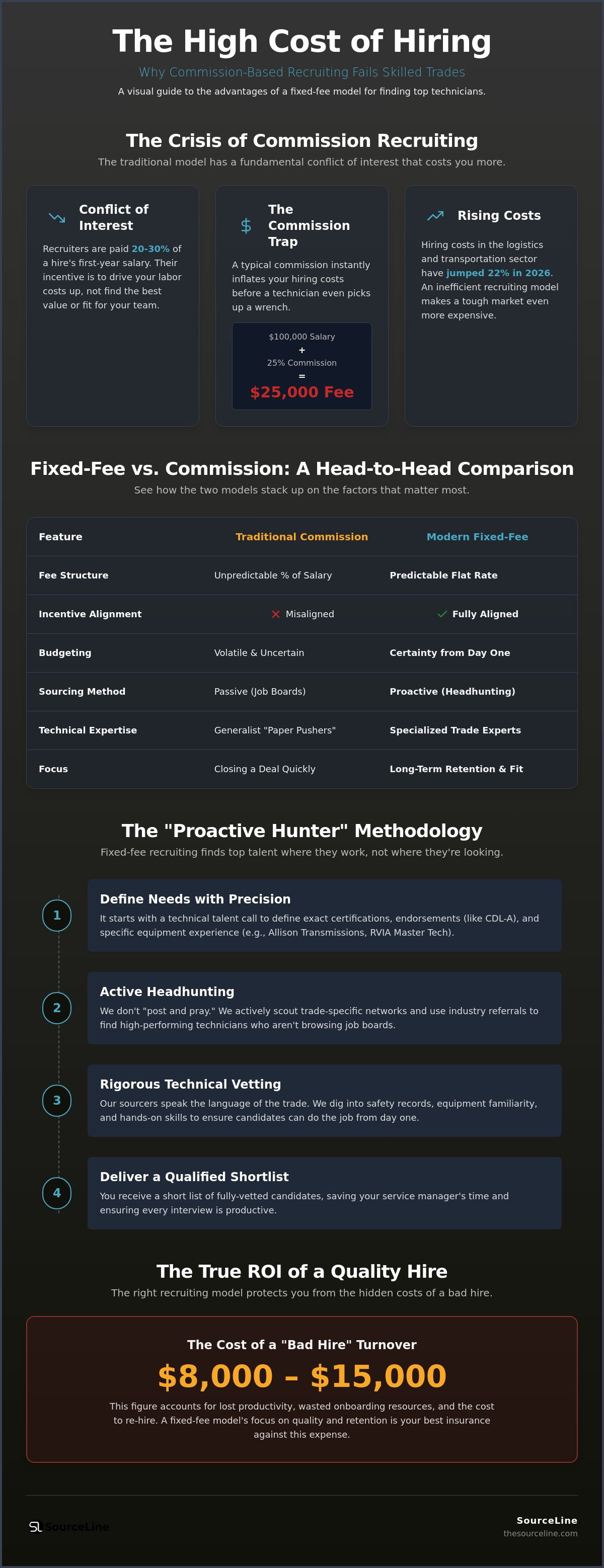
The old model is broken. Commission-based recruiters have a built-in incentive to inflate salary negotiations. The more the candidate makes, the bigger their paycheck. This creates a fundamental conflict of interest that works directly against your service department’s budget. For roles like heavy equipment mechanics and diesel technicians, where competitive pay is essential, this conflict can cost you thousands.
Making matters worse, the skilled trade shortage is a real and growing problem. Projections show a significant gap in qualified technicians by 2026. Simply posting a job and waiting for applicants is no longer a viable strategy. You need a proactive partner, a "hunter" who actively seeks out the top talent that isn't looking. This is where the fixed-fee model truly shines, aligning the recruiter’s goals directly with yours: finding the best person for the job, not just the most expensive one.
Whether you are managing a specialized service center or a comprehensive freight and logistics provider like Tranzit Express Inc., the goal remains the same: securing reliable, high-quality talent that keeps the business moving efficiently.
The Hidden Costs of Percentage-Based Fees
A 20-30% commission on a technician's salary is more than just a line item. It’s a significant drain on your budget that could be reinvested into new tools, training programs, or better benefits to improve retention. For every five technicians you hire, you’re essentially paying for a sixth who never shows up.
This high cost often leads to hiring hesitation. Managers delay bringing on needed staff, forcing the existing team to work overtime and leading to burnout. Productivity suffers, and valuable revenue is lost. The traditional model also encourages "fee-jumping," where recruiters move the same candidate from job to job to collect multiple commissions, leaving you with a retention nightmare.
Misalignment in the Transportation Labor Market
Most generalist recruiters don’t speak your language. They lack the technical vocabulary to distinguish a master-certified RV technician from a general mechanic or understand the specific diagnostic tools used in a heavy equipment shop. They push resumes based on keywords, not on proven skills and cultural fit.
You need a technical talent sourcer, not a paper pusher. You need a partner who understands the difference between various engine platforms and hydraulic systems. The fixed-fee model provides the cleanest line of sight between your hiring need and a positive return on investment, because the focus is on quality and fit, not just filling a seat to cash a check.
How Fixed-Fee Recruiting Works for Specialized Trades
The fixed-fee process is built on transparency and partnership. It starts with an in-depth talent call where the recruiter works to understand not just the job description, but your shop’s culture, workflow, and long-term goals. From there, the recruiter actively hunts for qualified candidates, leveraging industry networks and proprietary databases that go far beyond public job boards.
A crucial step is pre-screening for specific, non-negotiable qualifications. This includes verifying certifications like CDL-A for drivers, ASE certifications for truck mechanics, or manufacturer-specific training for heavy equipment technicians. This rigorous vetting ensures you only speak with candidates who are genuinely qualified, saving you countless hours of interview time.
Because the fee is fixed, you can forecast your hiring budget with complete accuracy. Whether you're hiring one master technician or building out an entire second shift, the costs are predictable. This eliminates the "salary penalty," where you end up paying a higher recruiting fee simply because you chose to offer a competitive wage to attract top talent.
Sourcing vs. Screening: The Flat-Fee Advantage
Specialized trade recruiting requires looking where others don’t. The best technicians are often passive candidates; they are employed and not actively scrolling through job ads. A fixed-fee partner focuses on sourcing these individuals through direct outreach and relationship-building.
This active approach is paired with intense technical vetting. By asking the right questions upfront, the recruiter filters out candidates who look good on paper but lack real-world experience. This dramatically reduces the risk of a "bad hire" and the associated turnover costs. In this model, the recruiter acts as a true extension of your team, dedicated to finding a long-term solution.
Predictability in Multi-Role Hiring
Are you planning to scale your service center or dealership? A flat-fee model is the only practical way to hire five or more technicians at once without destroying your budget. The cost remains consistent, allowing you to plan your expansion with financial certainty.
This approach is built for the realities of skilled trades. SourceLine’s specialization covers the industries where this talent is most needed, including the RV and motorhome industry, marine service centers, heavy truck repair, and powersports dealerships. The focus is always on finding the right fit for your specific operational needs.
Fixed Fee vs. Contingency: The 2026 ROI Comparison
The financial difference between fixed-fee and contingency recruiting is stark, especially as skilled trade salaries continue to rise. When the fee is tied to salary, your costs become unpredictable and penalize you for being a competitive employer. A fixed fee de-risks the entire hiring process.
Time-to-fill is another critical metric. Contingency recruiters often juggle dozens of open roles, giving priority to the ones with the highest potential commission. A fixed-fee "hunter" is engaged on a specific search, dedicating their resources to finding your candidate quickly. This focus, combined with a replacement guarantee like SourceLine’s 30-day window, provides a level of security that contingency firms rarely offer.
Finally, consider the psychological impact. When hiring managers know the recruitment fee is fixed, they can focus solely on finding the best candidate for the role. They are free to offer a competitive salary without worrying about driving up administrative costs, leading to better decisions and better hires.
Breaking Down the Math
Let's look at a common scenario: hiring a skilled diesel mechanic with an annual salary of $85,000.
Contingency Model (at 20%): The recruiting fee would be a staggering $17,000. If you offer more to land a top-tier candidate, say $95,000, that fee jumps to $19,000.
Fixed-Fee Model: You pay one flat rate, agreed upon upfront. This fee is often less than half of the typical contingency commission, saving you thousands of dollars on a single hire.
Where do those savings go? They can be reinvested directly into your business. You can fund better diagnostic tools, offer signing bonuses, or enhance your benefits package to improve long-term retention. For small to mid-sized dealerships and service centers—like Stone Road Auto, which focuses on providing high-quality pre-owned vehicles—a fixed-fee model doesn't just save money; it de-risks the hiring decision and frees up capital for growth.
Long-Term Retention and Quality
A recruiter’s motivation is directly tied to their fee structure. A contingency recruiter chasing a commission is incentivized to close the deal fast. A fixed-fee recruiter is incentivized to find a candidate who stays, because their reputation and future business depend on it.
This leads to a greater focus on "cultural fit" and long-term potential. The conversations are more honest, and candidate representation is more transparent. This "No-Nonsense" approach ensures that the person who shows up for their first day is the same person who was described to you, ready to contribute from day one.
Evaluating a Fixed-Fee Partner for Niche Transportation Roles
Not all fixed-fee recruiters are created equal. When hiring for highly specialized roles in the heavy equipment, marine, or RV industries, you need a partner with deep, proven expertise. Their ability to source talent effectively depends entirely on their knowledge of your world.
Start by verifying their industry-specific experience. A firm that primarily places office staff will not understand the nuances of hiring a certified Caterpillar mechanic. You need a specialist. Assess their reach as well. Can they recruit nationwide to find talent for your rural dealership or service center? The best technicians are often willing to relocate for the right opportunity.
Finally, look for a "hunter" mentality. Ask about their process for finding passive candidates. Do they have a proprietary talent pool, or do they just use the same job boards you do? The right partner will have an active, outbound strategy for engaging the top 10% of talent that your competitors can't reach. For a deeper dive into this approach, see our guide on how to find heavy equipment mechanic headhunters.
Questions to Ask Your Recruiter
Before you sign any agreement, ask these direct questions to vet a potential recruiting partner:
"How do you vet a technician’s mechanical proficiency and hands-on skills?"
"Do you charge extra for sourcing passive candidates who aren't actively looking for a job?"
"What is your exact replacement policy if the hire leaves or is terminated within the first month?"
Red Flags in Transportation Recruiting
Be wary of recruiters who exhibit these warning signs, as they often indicate a lack of specialized knowledge or transparent practices:
They don’t know the difference between a Class A and a Class B technician or other industry-specific roles.
Their agreement includes hidden "administrative fees" or other charges on top of the flat rate.
They rush past the strategy phase without a dedicated talent call to understand your unique needs and shop culture.
SourceLine: The Direct Alternative to Commission Recruiting
SourceLine was built to solve the core problems of traditional recruiting in skilled trade industries. We are a specialized, flat-fee authority for businesses that depend on high-quality technicians, mechanics, and drivers. We don't do temporary staffing or percentage-based fees. We deliver results.
With over 20 years of collective experience, our nationwide US reach allows us to find talent wherever it exists. We serve a core group of industries we know inside and out: heavy equipment and construction, heavy truck, marine, RV, and powersports. Our promise is simple and direct: No commissions. No nonsense. Just a better way to hire.
The SourceLine Methodology
Our process is designed for clarity and efficiency. It begins with the Talent Call, a deep-dive session where we calibrate the search to your specific technical needs and shop culture. This ensures we are perfectly aligned from day one.
Next, we launch a Proactive Sourcing campaign. Our team hunts for the top 10% of talent—the experienced professionals who aren’t on job boards. We vet, screen, and present only the most qualified candidates. Our terms are transparent: you pay a simple flat fee only when your new hire starts, and every placement is backed by our 30-day replacement guarantee.
Starting Your Search Today
Stop overpaying for underqualified candidates. The one-time engagement model is efficient, predictable, and built for the demands of your industry. If you're ready to hire smarter, it's time to talk.
Book a Talent Call to Start Hiring Smarter
Frequently Asked Questions
What is the difference between fixed-fee and contingency recruiting?Fixed-fee (or flat-fee) recruiting involves a single, predetermined price for a candidate search, regardless of the final salary. Contingency recruiting charges a percentage of the candidate's first-year salary, typically 20-30%, making it more expensive and less predictable.
How does fixed-fee recruiting save money for transportation companies?It saves money by eliminating high, unpredictable commissions. The savings on a single hire can be thousands of dollars, which can be reinvested into the business. It also reduces costs associated with bad hires by focusing on quality and long-term fit.
Does a flat-fee model work for specialized roles like RV technicians?Yes, it's ideal for specialized roles. A flat-fee recruiter is motivated to understand the specific technical requirements of a role, like an RV technician, to ensure a successful long-term placement, rather than just filling the position quickly to earn a commission.
What happens if a flat-fee hire doesn’t work out?Reputable fixed-fee firms offer a replacement guarantee. For example, SourceLine provides a 30-day guarantee. If the candidate leaves or is terminated for performance reasons within that period, we will conduct a new search at no additional cost.
Is fixed-fee recruiting better for nationwide searches?Absolutely. A fixed-fee partner engaged for a nationwide search can focus all their resources on finding the best talent, wherever they are located, without being distracted by other commission-based roles. This is critical for finding skilled technicians for rural or remote locations.
Why do most recruiters use a percentage-based commission model?The commission model is a long-standing tradition in the recruiting industry. It can be highly profitable for recruiters, especially when placing high-salaried executives. However, it is poorly suited for the skilled trades, where it creates a conflict of interest and penalizes employers for offering competitive wages.
Can fixed-fee recruiters find passive candidates as well as headhunters?Yes. In fact, the best fixed-fee recruiters operate as dedicated headhunters. Their "hunter" model is based on proactively sourcing passive candidates—those who are currently employed and not actively looking—which is essential for finding top talent in a tight labor market.
How much can I expect to save using a flat-fee model for diesel mechanics?For a diesel mechanic earning $85,000, a 20% contingency fee would be $17,000. A typical flat fee for a similar search could be significantly less, potentially saving you between $7,000 and $10,000 on a single hire.


Comments