.png)
Flat Fee vs Contingency Recruiting: Which Model Fits Your Shop?
In the heavy equipment and marine industries, percentage-based recruiting fees actually punish you for paying your best technicians what they are worth. It feels backward to pay a recruiter more just because you secured a high-performing lead mechanic. When comparing flat fee vs contingency recruiting, many shop owners realize that traditional models often work against their budget.
You probably already know the headache of unpredictable hiring costs. It is frustrating to work with recruiters who do not understand the difference between a diesel tech and an auto mechanic. You need a strategy that provides a predictable budget and technicians who stay long-term. This guide compares the costs and results of both models to help you find the best fit for your business.
We will look at the real-world impact of these fee structures on your cost per hire. You will learn how to choose a partner who understands the mechanical trades and focuses on quality over quick placements. By the end, you will have a clear path to building a more stable and profitable service department.
Table of Contents
Understanding the Basics of Recruiting Fees
Hiring a new technician is an investment in your shop's future. Recruiting fees are simply the costs you pay to find and hire these new employees. For most shop owners, these fees feel like an unpredictable expense that is hard to control. You need a lead mechanic or a master RV technician, and you don't have time to sift through hundreds of bad resumes. Understanding the recruitment process is the first step toward taking control of your hiring budget. Most agencies rely on old methods that might not fit the specific needs of the skilled trades.
What Is Contingency Recruiting?
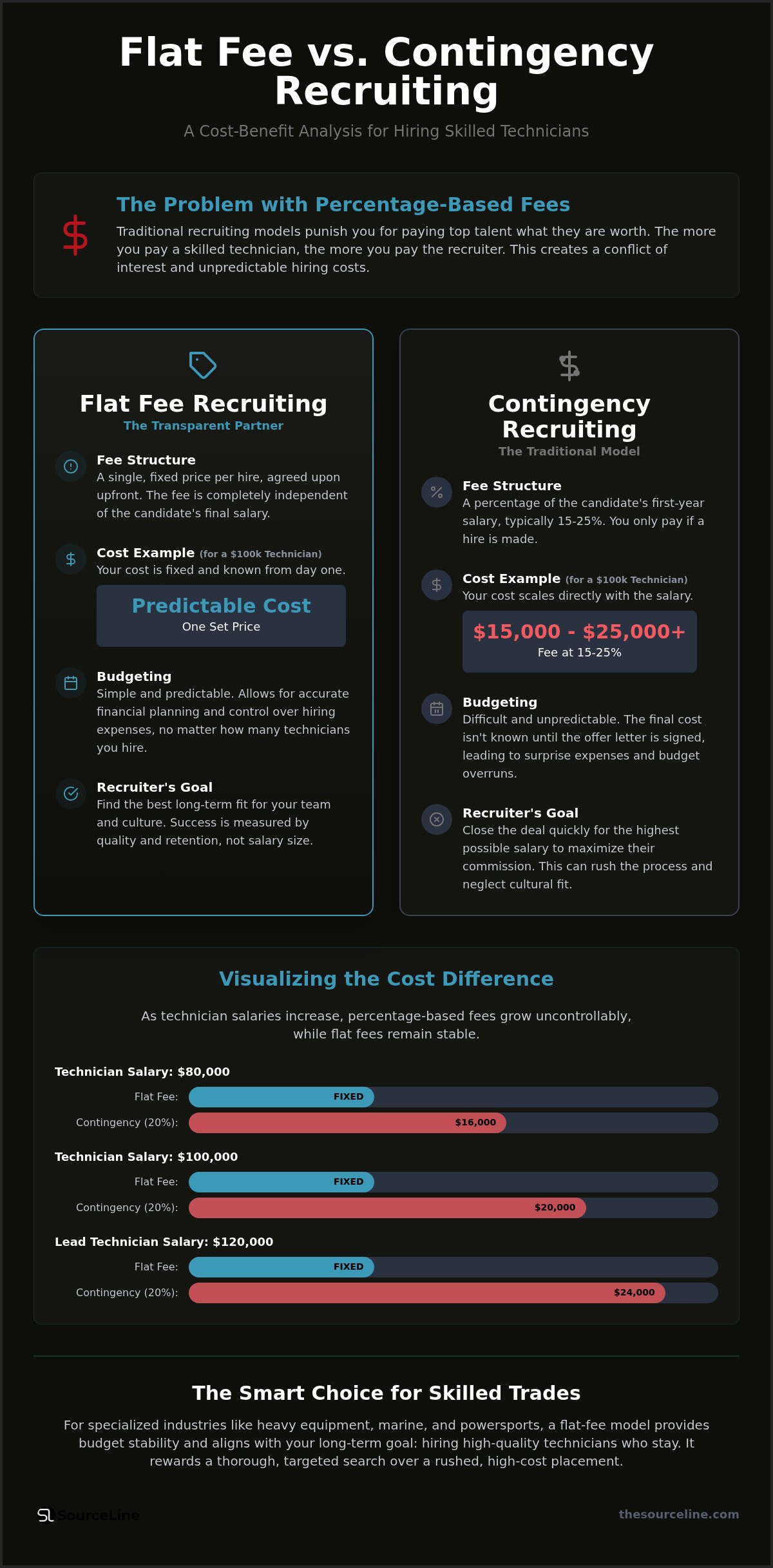
Contingency recruiting is the model used by most staffing agencies. It operates on a no-win, no-fee basis. You only pay the recruiter if you hire the person they presented. This sounds safe, but it often leads to high costs and misaligned goals. The agency takes a percentage of the candidate's first-year salary as their payment. These fees typically fall between 15% and 25%. If you hire a specialized technician for $100,000, the fee is staggering. It also means the recruiter makes more money if you pay the candidate more. This can drive up your total costs without necessarily improving the quality of the hire.
What Is Flat Fee Recruiting?
Flat fee recruiting is a modern alternative that simplifies your budget. Instead of a variable percentage, you pay one fixed price for the work. The fee stays the same regardless of what you decide to pay your new hire. This model focuses on the proactive work of finding and screening candidates who actually fit your shop culture. When comparing flat fee vs contingency recruiting, the flat fee model is much more transparent. It allows you to plan your recruiting spend months in advance. You won't face surprises when you finally find that perfect heavy equipment mechanic. This approach functions like a proactive hunter. We don't just wait for people to apply. We go out and find the technicians who aren't even looking for a job yet. You can see how this works on our pricing page.
Choosing the right path depends on your hiring volume and your specific industry. If you are in a niche sector like marine or powersports, you need a partner who speaks the language. Generalist contingency recruiters often lack the technical knowledge required to vet a diesel mechanic properly. They might send you dozens of resumes hoping one will eventually stick. A flat fee approach typically involves a more targeted search. It rewards efficiency and quality over just throwing names at a wall. When you analyze flat fee vs contingency recruiting, you see that the flat fee model is built for businesses that want to scale without losing control of their finances.
Comparing the Costs of Every Hire
Every shop owner knows the sting of a surprise bill. When you use traditional agencies, the cost of a new hire is a moving target. You won't know the final price until you sign the offer letter. This makes it impossible to manage a tight service department budget effectively. When analyzing flat fee vs contingency recruiting, the difference in total spend becomes clear very quickly.
The Math Behind Percentage Fees
Contingency fees are tied directly to what you pay your new employee. If you hire a lead diesel mechanic for $100,000, a 20% fee means you owe the agency $20,000. High demand for skilled trades is pushing wages higher every year. As these salaries climb, your recruiting costs skyrocket right along with them. These fees can quickly drain your annual budget, leaving you with less money for shop equipment or training. There is also a hidden pressure in this model. Agencies want to close the deal fast to get paid. This can lead to rushed hiring decisions that don't benefit your shop in the long run.
The Predictability of Flat Fees
Flat fees offer a better way to manage your cash flow. You know the exact price before the search even starts. This transparency allows you to plan your quarterly expenses without any guesswork. Different flat fee recruitment structures exist to fit different business sizes. Whether you are hiring one tech or ten, the cost per hire stays stable. This model removes the conflict of interest found in percentage-based fees. We focus on finding the right fit for your culture because our pay isn't tied to the final salary. You can see how we structure these costs on our pricing page.
Beyond the initial bill, you have to think about long-term ROI. A hire who quits after three months is the most expensive mistake you can make. Contingency recruiters often prioritize speed over retention because they are competing with other agencies. Flat fee models allow for a more thorough screening process. You get a candidate who is vetted for technical skill and long-term potential. This lowers your turnover and keeps your bays full of productive technicians. If you want to see how this fits your specific shop, explore our heavy equipment recruiting services.
Why Percentage Fees Struggle in the Skilled Trades
Traditional recruiting models were built for corporate office jobs. They don't account for the unique challenges found in a service bay or a construction site. In the skilled trades, finding talent is about technical expertise and specific knowledge. Percentage-based fees often encourage volume over quality. This leads to a "spray and pray" approach that wastes your valuable time.
A recruiter working on contingency only gets paid if they make a placement. This creates a rush to send as many resumes as possible to your desk. They hope one candidate will eventually stick so they can collect their fee. For a busy service manager, this means hours spent reviewing unqualified applicants. It is an inefficient way to run a shop and delays your ability to get equipment back in the field.
The Problem with Generalist Recruiters
Many recruiters don't know the difference between an RV technician and an auto mechanic. They see the word "technician" on a resume and assume it fits your opening. This leads to interviews with candidates who lack the right certifications or specialized toolsets. You need specialized sourcing for industries like marine recruiting and powersports. Generalist firms simply don't have the industry depth to vet these roles properly. They focus on filling seats rather than finding experts who can hit the ground running.
Finding the Top 10% of Technicians
The best technicians are rarely looking at job boards. They are already working in another shop and are likely treated well. To find these A-players, you have to go and get them. This requires proactive hunting rather than waiting for an application to arrive in your inbox. A recruiter needs to understand the technical details of the job to even start a conversation with a top-tier tech. They must be able to speak the language of the trade to build trust with passive candidates.
When you analyze flat fee vs contingency recruiting, the flat fee model provides the dedicated time needed for this deep search. Contingency recruiters often give up on hard-to-fill roles if they can't find a quick win. A flat fee partner is committed to the search because the goals are aligned from day one. We focus on the quality of the match because we want to build a long-term partnership with your shop. This approach ensures you aren't just getting the most available person, but the best one for the job.
How to Choose the Best Model for Your Business
Choosing between models requires a look at your long-term goals. You should start by evaluating your planned hiring volume for the next year. If you expect to hire three or more technicians, a flat fee model usually saves you a lot of money. It prevents the cost of growth from spiraling out of control.
Look at the average salary for the roles you need to fill. High-demand roles like diesel mechanics or lead service managers command higher pay. A percentage-based fee on a $90,000 salary is much harder to swallow than a predictable flat rate. You want your money going toward your team, not an agency's commission.
Consider how much time your service managers spend on screening resumes. If they are sifting through 50 applications just to find one decent interview, they aren't managing the shop. A good recruiting partner should handle that heavy lifting for you. They should understand the difference between a parts changer and a diagnostic expert.
Questions to Ask Your Recruiting Partner
You need to know if a partner truly understands your world. Ask if they charge a percentage or a fixed fee up front. Transparency here tells you a lot about how they operate. If they can't give you a straight answer on costs, they probably aren't the right partner.
Ask about their specific experience in heavy equipment recruiting or trucking. Can they explain the difference between hydraulic systems and basic engine repair? If they can't, they won't be able to vet your candidates properly. You need an expert who speaks the language of the trades.
Find out how they screen for technical skills. Do they just look for keywords on a resume? You want a partner who conducts deep interviews to verify actual mechanical ability. This ensures you only spend time interviewing people who can actually do the work.
Signs You Should Switch to Flat Fee
It is time to rethink your strategy if you were shocked by the size of your last recruiting invoice. Paying $20,000 or more for one placement is a massive hit to your bottom line. That money could have gone toward new shop tools or technician bonuses. Predictable costs make it much easier to run a profitable shop.
Another sign is receiving resumes for candidates who are not qualified. This means the recruiter is just playing a numbers game. They are hoping you will do the work of training someone who isn't ready. When you compare flat fee vs contingency recruiting, you see that flat fees reward the recruiter for finding the right match, not just any match.
When you need to hire multiple people for the same department, the flat fee model is the clear winner. You can plan your budget with confidence. You won't have to worry about your recruiting costs doubling just because you found two great techs instead of one.
The SourceLine Approach to Flat Fee Recruiting
SourceLine is not a general staffing agency. We focus exclusively on the industries we know best, like heavy equipment, RV, and marine. Our model is built for shop owners who are tired of the traditional recruiting game. When you analyze flat fee vs contingency recruiting, you see that we have removed the typical conflict of interest. We don't get a raise just because you pay your new hire more.
In a contingency model, the recruiter makes more money if you pay the technician a higher salary. This does not help your shop's bottom line. Our flat fee approach ensures our goals are aligned with yours from the start. We act as a proactive hunter for your next RV technician or diesel mechanic. Our goal is to build long-term partnerships with dealerships and fleets rather than chasing a quick commission.
Expertise in Technician-Driven Industries
We talk to candidates and employers in the mechanical trades every single day. This constant communication gives us deep market intelligence that general recruiters lack. We understand the specific trends affecting your shop right now, from local wage shifts to the shortage of master-certified techs. For a deeper look at how this works, read our guide on recruiting agencies without placement fees.
General agencies often treat technicians like office workers. They don't understand the importance of a clean driving record or a specific toolset. We vet for these details before a candidate ever reaches your desk. This saves your service manager from wasted interviews and bad hires. We focus on the quality of the person to ensure they have the technical skills and the right attitude for your shop culture.
Get Started with a Predictable Hiring Plan
It is time to stop overpaying for placements and start investing in your team. A predictable hiring plan allows you to grow your business without financial surprises. We provide the market data you need to make informed decisions about your workforce. This helps you stay competitive in a tight labor market where every technician counts.
Contact us today to see how we can help your business grow. We will help you move away from the high costs and unpredictability of traditional staffing. Start finding the high-quality technicians you need to keep your bays full and your customers happy. Your shop deserves a recruiting partner who actually knows the trades.
Take Control of Your Hiring Budget
Traditional recruiting models often feel like a gamble. You shouldn't have to choose between finding top talent and maintaining a predictable budget. Deciding between flat fee vs contingency recruiting determines whether your shop stays profitable or struggles with unpredictable overhead. Flat fees ensure you know exactly what you are paying before the search begins.
With over 20 years of industry experience, we understand the specific needs of RV, Marine, and Heavy Equipment shops. We focus on finding technicians who have the right technical skills and the desire to stay long-term. This proactive approach removes the stress of high turnover and hidden placement costs. You can finally stop overpaying for talent and start investing in the growth of your own service department.
Your shop deserves a partner that understands the mechanical trades as well as you do. Build a more stable team and a more predictable budget starting today.
Frequently Asked Questions
What is the main difference between flat fee and contingency recruiting?
The primary difference between flat fee vs contingency recruiting is how you pay for the service. A flat fee model uses a fixed price that is set before the search starts. Contingency recruiting charges a percentage of the candidate's first-year salary. This means your costs stay predictable with a flat fee but can skyrocket with contingency if you hire a high-earning technician.
Is flat fee recruiting better for small businesses?
Yes, it provides budget certainty that small shops often need to stay profitable. A single high-percentage fee from a traditional agency can wipe out a small business's monthly margin. Fixed pricing allows a small shop to compete for top-tier talent without the risk of an unpredictable invoice. It makes it much easier to plan for growth without financial surprises.
Why do contingency recruiters charge a percentage of salary?
This is an old industry standard designed to reward recruiters for filling high-paying executive roles. Agencies argue that more expensive roles are harder to fill and require more work. In the skilled trades, this model often works against the employer. It ties the recruiter's commission to your payroll costs, which creates a conflict of interest during salary negotiations.
Can I use flat fee recruiting for one-off hires?
You can absolutely use this model for a single opening. You don't need a massive hiring plan to benefit from fixed costs. Whether you need one lead mechanic or a whole new service team, the process remains the same. It is an effective way to test a specialized recruiting partner without committing to a long-term contract or high-risk fees.
Does flat fee recruiting include candidate screening?
Quality flat fee services include deep technical screening as a standard part of the process. We vet candidates for specific certifications and hands-on experience before you ever see a resume. This prevents your service manager from wasting time on interviews with unqualified applicants. The goal is to present a small group of high-quality matches rather than a pile of random resumes.
How much can I save by switching from contingency to flat fee?
You can save thousands of dollars per hire, especially for senior roles. When analyzing flat fee vs contingency recruiting, the savings become more obvious as technician wages rise. A 20% fee on a $90,000 lead tech salary costs you $18,000. A flat fee is typically much lower than that, allowing you to keep more money in your shop for equipment and bonuses.
What happens if a candidate hired through a flat fee model leaves?
Most professional flat fee partners provide a replacement period to protect your investment. If a new hire leaves within a set timeframe, the agency will conduct a new search at no additional cost. This ensures the recruiter is focused on finding a long-term fit rather than just a quick placement. Always verify the specific length of the replacement period before signing an agreement.
Why do skilled trade industries prefer flat fee models?
Flat fee models reward the proactive hunting required to find talent in a tight labor market. The best technicians are usually already working and aren't looking at job boards. This model allows recruiters to spend the necessary time digging for these passive candidates. It prioritizes the technical match and long-term retention over the speed-based "spray and pray" methods used by many contingency firms.


Comments